###
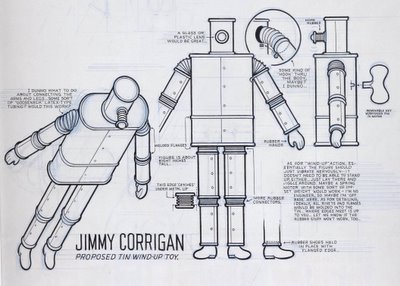 Based on the traffic from my last post ("Drawing With Your Brains") I thought it was important to spell out my views on Chris Ware's artwork:
I enjoy Chris Ware's work, but the highbrow critics currently fawning over him drive me absolutely bats. Ware is being offered up as one of the few "Masters of American Comics" (the title of the exhibition at the Los Angeles Museum of Contemporary Art) and is feted at the Whitney Museum and in the pages of the New Yorker. Here is what the LA museum catalog says about him:
"I don't think anyone in any visual medium is making art that is more elevating."
"Ware is capable of creating beauty anywhere and always. Ware's work, in this way, is also quite like Bach's."
"There's glory there. We look at his work and we think of words like sumptuous and exacting and rhapsodic."
"His use of the page is unparalleled."
These people are morons.
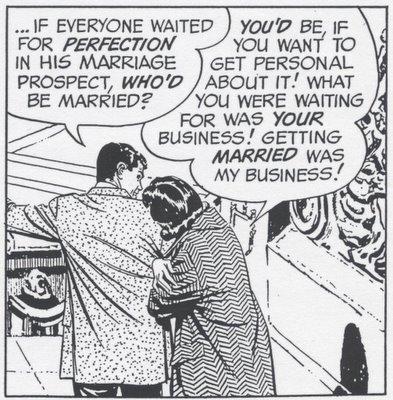
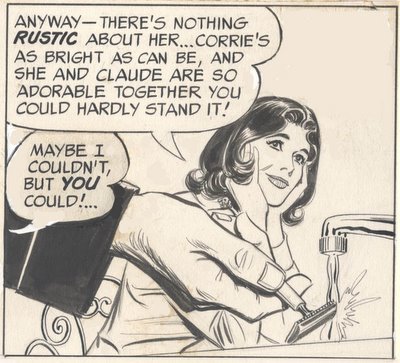
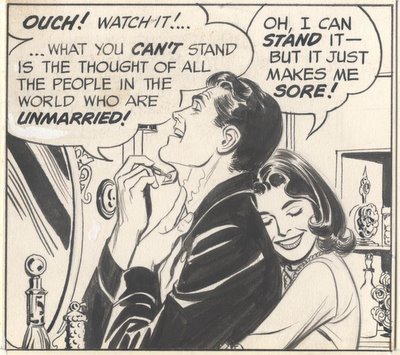
50 years ago, there were a thousand key line and paste up artists working for subsistence wages in commercial art studios across the country. They would sit at a drawing board with a T-square and a triangle, creating ads for the backs of comic books and other lofty venues. Virtually all of them could draw as well as Chris Ware. Many could draw better. But because that was an era with different standards, they would have laughed at the suggestion that their drawings were good enough to hang in a museum. Today those key liners have all disappeared, swept aside by technology and the invisible hand of Adam Smith. But Chris Ware is hailed for the same mechanical drawing skills.
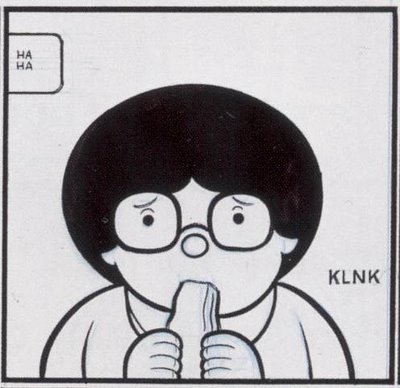 I don’t begrudge any artist who wins the lottery in today's society, whether it’s Chris Ware or Thomas Kinkade. Ware has some admirable qualities. He is a decent writer and a diligent artist who has created his own interesting world. He is disciplined enough to create a substantial body of work, and the cumulative effect is certainly showy. But if you deconstruct his accomplishment, you will find it easier to evaluate.
 Ware’s work combines three disciplines: artist, graphic designer and writer. Taking them in order, it is hard to argue that his "art"-- the actual drawings inside the panels-- is anything better than competent. He draws in a monotone, with little of the variety, the sensitivity or wisdom of line, the composition, design, or the other qualities that have traditionally been the hallmark of great drawing. Ware would have made an excellent key liner, and that was an honorable profession, but anybody knowledgeable about sequential art or illustration should have no trouble identifying 500 superior artists. As an aside, Ware also hasn’t discovered that an artist who wants to depict a repetitive and bleak life cannot simply resort to repetitive and bleak drawings. Important lesson.
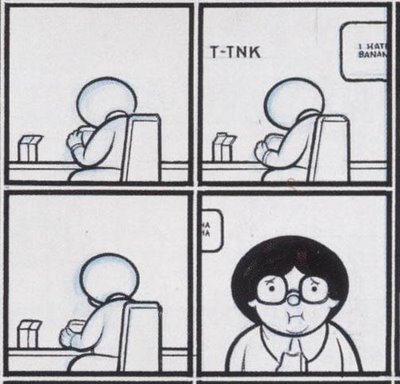 Weak drawing skills are not fatal to a creative enterprise, so let's move on and talk about Ware's second (and more important) discipline, graphic design. Ware is more a designer than an artist. His work is interesting and sometimes complex. However, the critic who wrote, “he really has no stylistic predecessors….No one can do what he does, so no one is even trying” has obviously never heard of constructivism or the modernist school of commercial design 80 years ago. He must have been oblivious to the thousands of labels and posters and advertisements by underpaid and anonymous commercial artists who invented Ware’s style.
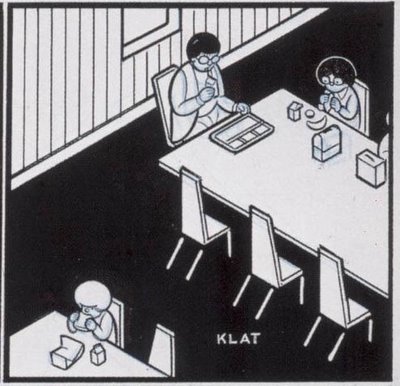 That leaves the third component, his words. This is extremely important because the whole thrust of the "concept art" school is that so long as you are diagramming great thoughts or peerless words, it doesn't matter that you are not an accomplished artist measured by traditional standards. My own view is that Ware’s words cannot compare with an excellent essay, play, or poem, but you can form your own opinion. I suspect that mainstream critics pay attention to Ware's words only because they are enhanced (or redeemed) by the clever diagrams. And that leads us to the bottom line:
Establishment art critics, always late to the party, think they are cool when they descend to the subculture of graphic novels and sequential art. Yet, they can never manage to untangle the words from the pictures to make an honest appraisal of either one. Literary critics tend to say "this person writes pretty well for an artist" while art critics tend to say "this person draws pretty well for a writer." But as a general rule one can't produce great works of art by combining merely good words with merely good pictures. Chris Ware's art is, IMO, merely good. But that's not so bad.
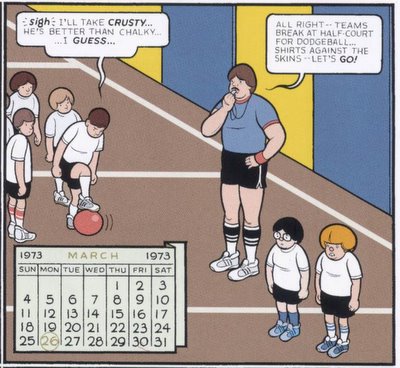 I hope this fleshes out my previous post on "Drawing With Your Brains." I have nothing against Chris Ware. I'm not sure he deserved to be singled out as a representative sample of the concept art phenomenon. However, I suppose that anyone who is repeatedly embraced as a genius has to be ready for alternative opinions.As with my previous post, I welcome any examples, jpgs, quotations or explanations of Ware's work that help me understand where I missed the boat.
###
I hope this fleshes out my previous post on "Drawing With Your Brains." I have nothing against Chris Ware. I'm not sure he deserved to be singled out as a representative sample of the concept art phenomenon. However, I suppose that anyone who is repeatedly embraced as a genius has to be ready for alternative opinions.As with my previous post, I welcome any examples, jpgs, quotations or explanations of Ware's work that help me understand where I missed the boat.
###



 Posts
Posts

