Definition List

ART THAT MATTERS

###


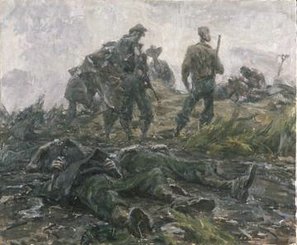
Australian war illustrator Ivor Hele painted jungle fighting in New Guinea during World War II. One day, three men in his unit were killed. Their bodies were left sprawled in the mud while the remaining troops scrambled to dig foxholes. Hele, who felt the tragedy must be recorded, crouched by the bodies to draw them. The soldiers watched him in grim silence.

Then it began to rain.

Without a word, several soldiers left the safety of their foxholes to build a makeshift shelter over Hele with sticks and a tarp so he could finish the precious drawing. These soldiers, who were in the midst of battling for their own lives, felt that Hele's drawing of their fallen comrades was so important that it was worth the risk. Hele later recalled their gesture as "my most moving event in New Guinea."


I would guess these soldiers did not have highly refined taste in art. They would probably flunk a quiz on the difference between modernism and postmodernism. Yet, Hele's experience shows how important and meaningful art can be to human life.

Art used to matter a lot. It is sometimes hard to remember art's original honesty and purpose over the din of today's petty rivalries and internecine squabbling between patrons, collectors, critics and artists.
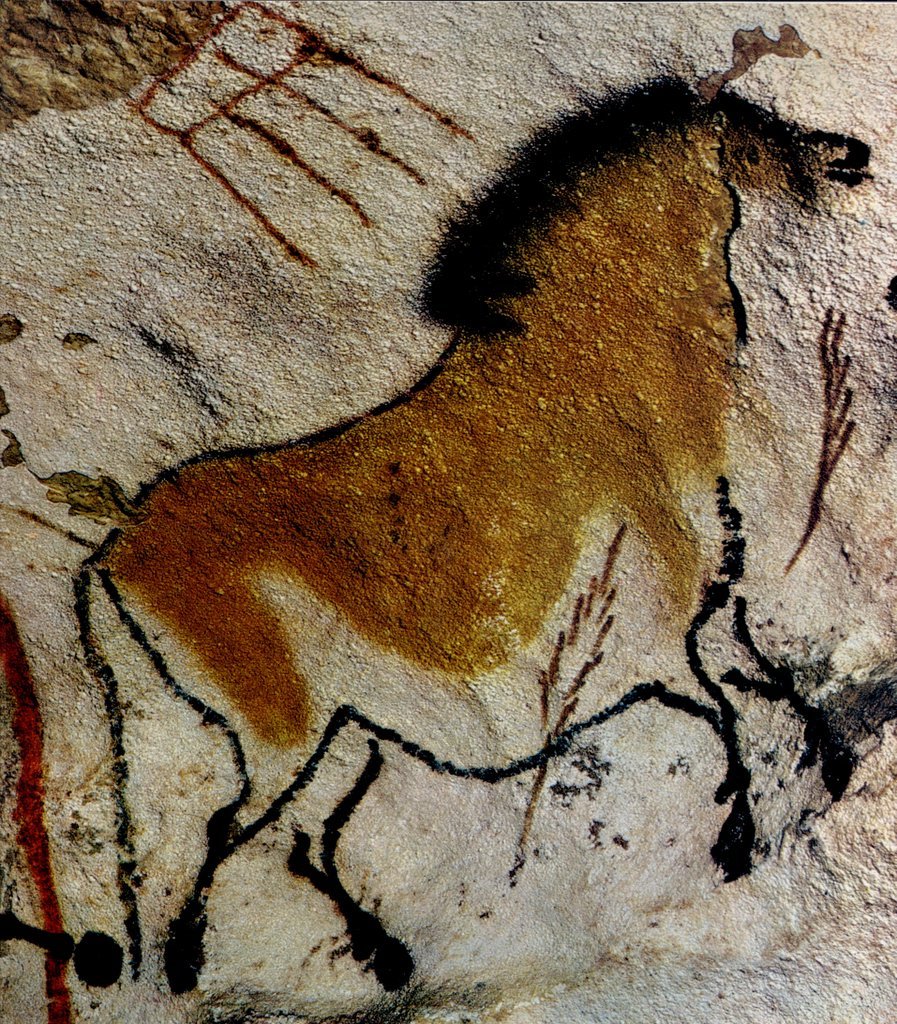


Art first appeared with the Cromagnons who were barely surviving in the midst of an ice age. They had no spare time for cultural luxuries. Yet, to make their paintings, these prehistoric artists would crawl and climb as far as a mile into dark caves carrying charcoal and the red earth which they used for color. The only light came from flickering grease lamps and pine torches which didn't cast enough light to detect the bears and other dangerous animals living in the caves. It was a very risky occupation to be a cave painter, yet something compelled them to do it anyway.

Art of this vitality and relevance seems pretty remote from most art today.

.
###

PAINTING WATER: THE MARRIAGE OF FREEDOM AND CONTROL

###


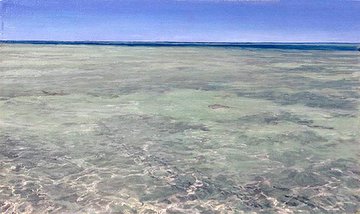
Sometimes it takes the greatest amount of self-discipline to capture the things that are most free and elusive. You might think that painting water-- that most fluid, shimmering substance-- would permit an illustrator to indulge in the wildest excesses. But I was surprised to discover that some of the painters who are best at capturing the freedom of water can only do so using the most exacting self-discipline and control. (There's probably a metaphor for life in there somewhere.)


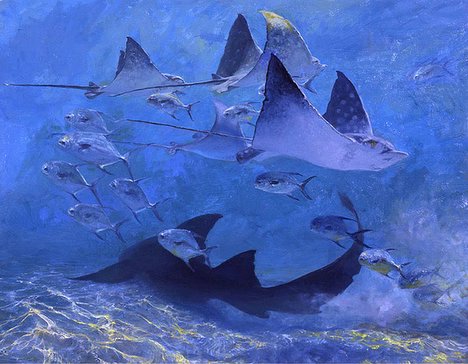
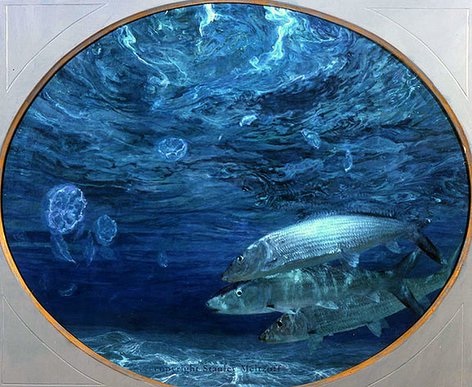
Stanley Meltzoff, whose spectacular paintings are featured in this and my previous post, described to me a similar process for painting water:

So far as I can tell depicting water depends on following the complex rules of illumination, refraction, reflection, color absorption, distortions of all these by the shape of the waves and the color of the bottom and supended particles, all in perspective. There are now computer dependent rules for depicting water in different wave shapes and lighting used by animators in making special effects. The instructions in computer language are beyond my understanding, but available. The How To books in art stores have simpler sets of instructions for painting water which, even if incomplete, are illuminating. So are the comments of John Ruskin in Stones of Venice, and even Gombrich in Art and Illusion. Current water painters do better analysing photographs and reconstructing the fluids in accord with the rules for making illusion, once they have spent some time looking at that particular structure of fluids in motion. I suppose mystics can do this by prayer or meditation, but the picture makers I am acquainted with are practical craftsmen, among whom there are some who can tell a story better than others. I suppose Moses could make water flow from a rock, but Meltzoff needs to use paint on gesso panels to create the illusion of water and wetness for others to contemplate.


Meltzoff went on to talk about the differences between capturing the world above water and the world underwater:

Let me say that painting underwater light and space involve more and other optical rules than water seen from above. The source of light is from above through the water surface. It is as if the waves seen from above were emiting light from beneath . The undersurface reflects in more complex ways than the surface above. Moreover the light is not in a continuous flow as in daylight, but is in distinct bands of focused light surrounded by large volumes of diminished and unfocussed light, in motion and overlapping. Atmospheric perspective and color absorption are more varied and affect varying wave lengths according to the optical processes and physics of water rather than those in air. The movement of bands of light underwater is quite unlike anything above water. With the exception of the undersurface and the bottom when visible, the rules of vanishing point perspective in air are useless underwater, except for single objects. It is not at all like painting en plein air. The same is true for the effect of gravity on vertical and horizontal structures which is so marked above water and clearly seen in vanishing point perspective.


Reflecting on Meltzoff's approach, I was struck by how hard he works to convey an evanescent, shimmering freedom and how successful he is at doing so. It shows how much you can achieve at the intersection where freedom and control come together. 

###
 

Privacy Policy

Popular Posts

Blog Archive