skip to main
|
skip to sidebar
###
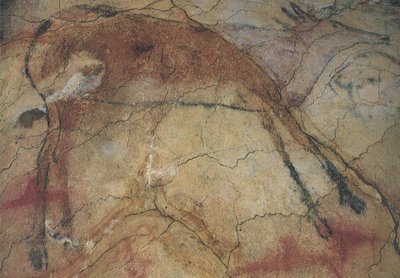 At the earliest red dawn of humanity, our ancestors slowly learned to use stone tools. For more than 2 million years they used stones in the same way: to bash or chop. It was a brutish existence that left no traces of art or culture behind.
Then, during the upper paleolithic period (35,000 to 12,000 years ago) stone technology took a great leap forward. Our ancestors learned how to select certain rocks that could be shaped into blades-- longer and lighter with more cutting surface. Using these stones, they developed tool making techniques that gave them ten times the cutting edge from the same sized stone.
This transformed their world. They could now use sharpened rocks for spear points and projectiles. They could cut with greater precision and for the first time make use of antler, ivory and bone. Hunting became easier. Conceptual thinking became more important to survival. The first signs of symbolic thought emerged. It was in this environment that the very first art began to appear, painted on cave walls and etched in bone. More artistic progress was made in those 25,000 years than in the preceding 2 million years combined.
Since those fragile beginnings, art continued to flourish in tandem with technology.
For example, Beethoven was able to revolutionize music partially because the invention of the piano gave him greater range and expressive capability than previous composers who grew up using the harpsichord.
And illustration art only became a phenomenon in the late 19th century when printing and photographic technology improved enough to reproduce artwork vividly and accurately for mass produced books and magazines. Without half tone engraving, there would have been no golden age of illustration.
It is useful to remember this long history in an era when technology sometimes seems dehumanizing and oppressive. Technology may push aside traditional art forms such as drawing and painting in favor of strange new art forms that screech and light up and move. But even the most sentimental among us (and I may qualify for that category myself) need to remain open minded as we assess the impact of technology on art.
The reason for my long, boring digression is that I want to chat in the next few installments about the nature of computers and digital art. I would love to engage in a dialogue with you dear readers about the future of art, and to be educated by you as I invariably am.
Are you ready?
###
###
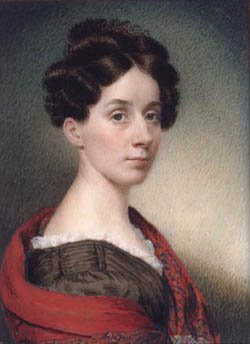
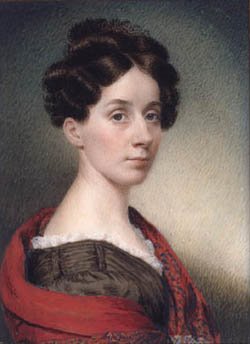
Sarah Goodridge (1788-1853) was born in a small village in Massachussetts, the sixth of nine children. Growing up in the country, she learned to draw by scratching pictures with a pin on birch bark. Eventually she made her way to Boston where she earned a living painting miniature portraits on ivory.
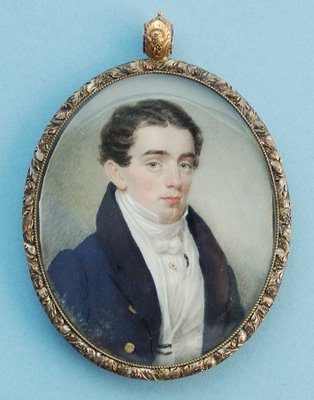
In the days before photography, such pictures were often worn in lockets or pinned to lapels.
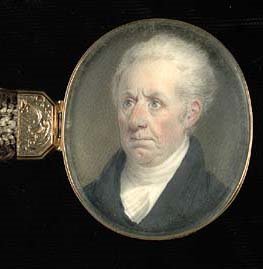
Goodridge's miniatures were very popular and she soon flourished as an independent artist-- a rarity for a woman in colonial America. By painting two or three portraits a week, she made enough to support her sick mother, her orphan niece, and other family members. Her career lasted for thirty years until her failing eyesight forced her to stop. She never married.
Goodridge did, however, develop a special friendship with the handsome young Boston lawyer Daniel Webster. The first time she painted Webster's portrait, he was married with three children. He sat for eleven more portraits over the next 25 years. Webster and Goodridge wrote each other frequently; she carefully preserved letters from him, while he seems to have carefully destroyed letters from her. When he moved to Washington to serve in government she visited him there twice.
After Webster's wife died in 1827, Goodridge secretly painted this miniature for him entitled Beauty Revealed (self portrait):
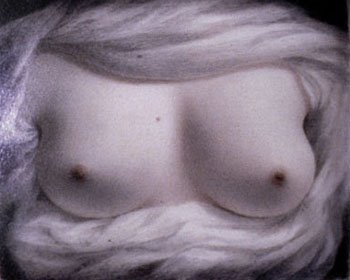
Sarah's daring self-exposure was unthinkable in an era when modesty was carefully preserved by several layers of clothing. Her painting crossed all kinds of boundaries-- social, sexual, religious and artistic. John Updike describes this little jewel as "the first known nude American portrait done from life."
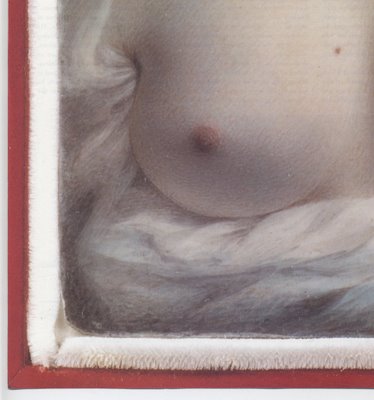
No one can ever be certain what Webster and Goodridge shared in private. Scholars have agreed that at a minimum, Goodridge's self-portrait told Webster, in the words of Updike, "we are yours for the taking." Could an object so small ever carry greater weight? Sarah's offering is not mere pigment on ivory. It shows how an artist invests a physical object with deep significance, and through that object reaches out to another human. It reminds me of Walt Whitman's impassioned effort to use a poem to reach beyond his mortality and touch some future reader who might be holding Leaves of Grass late at night:
Now lift me close to your face till I whisper,
What you are holding is in reality no book,
nor part of a book;
It is a man, flush'd and full-blooded -- it is I -- So long!
We must separate awhile --
Here! take from my lips this kiss;
Whoever you are, I give it especially to you;
Whatever their private relationship, Webster was politically ambitious and needed money, so Goodridge simply would not do for his second wife. He met and quickly married another woman, whose sole qualification seemed to be that she was from a wealthy and prominent family.
When Goodridge died, she left her beloved paint box to Webster.
As for Webster, he kept her tiny painting hidden amongst his personal effects until the day he died. It was discovered by his heirs and was eventually sold off.
This miraculous glimpse of a beating heart beneath the manners and undergarments of an earlier generation is now safely contained in an antiseptic museum showcase.
###





 Posts
Posts

