skip to main
|
skip to sidebar
###
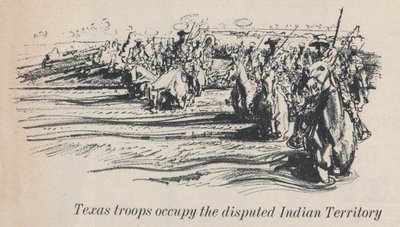 This lovely little drawing by Robert Fawcett appeared in Look Magazine in the 1960s. It was just a spot illustration, about 2 inches across. It is not likely to be reproduced ever again.
In the 1960s, illustration went wild. Innovators used psychedelic colors and bold new styles to create increasingly abstract work. Representational art was declared obsolete. Fawcett, who was trained in a rigorous traditional style, remained unperturbed. In fact, he was amused by the "misconception that abstract qualities are new to contemporary painting, whereas they have been the comparision of excellence since painting began."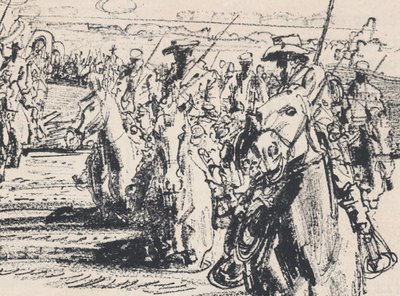 Today, all those daring 1960s illustrations with the LSD-inspired paisley designs seem quaint and dated. But if you revisit this tiny little drawing by Fawcett, you will see art that is wild in a more lasting, meaningful sense.
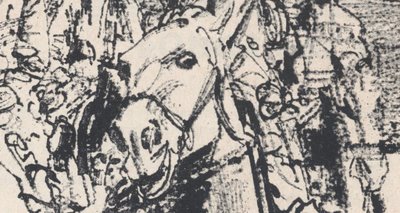 Fawcett often drew conventional subjects using conventional media. He was known for scenes of cultured people in English libraries. But don't be fooled by his subject matter-- he drew them with a powerful, vigorous line. This little drawing is like a DNA sample of the pagan force in Fawcett's drawing. It remains far more wild and frightening today than much of the work that "revolutionaries" such as Peter Max or Bob Peak were producing with the "new freedom" of that era.
###
Fawcett often drew conventional subjects using conventional media. He was known for scenes of cultured people in English libraries. But don't be fooled by his subject matter-- he drew them with a powerful, vigorous line. This little drawing is like a DNA sample of the pagan force in Fawcett's drawing. It remains far more wild and frightening today than much of the work that "revolutionaries" such as Peter Max or Bob Peak were producing with the "new freedom" of that era.
###
###
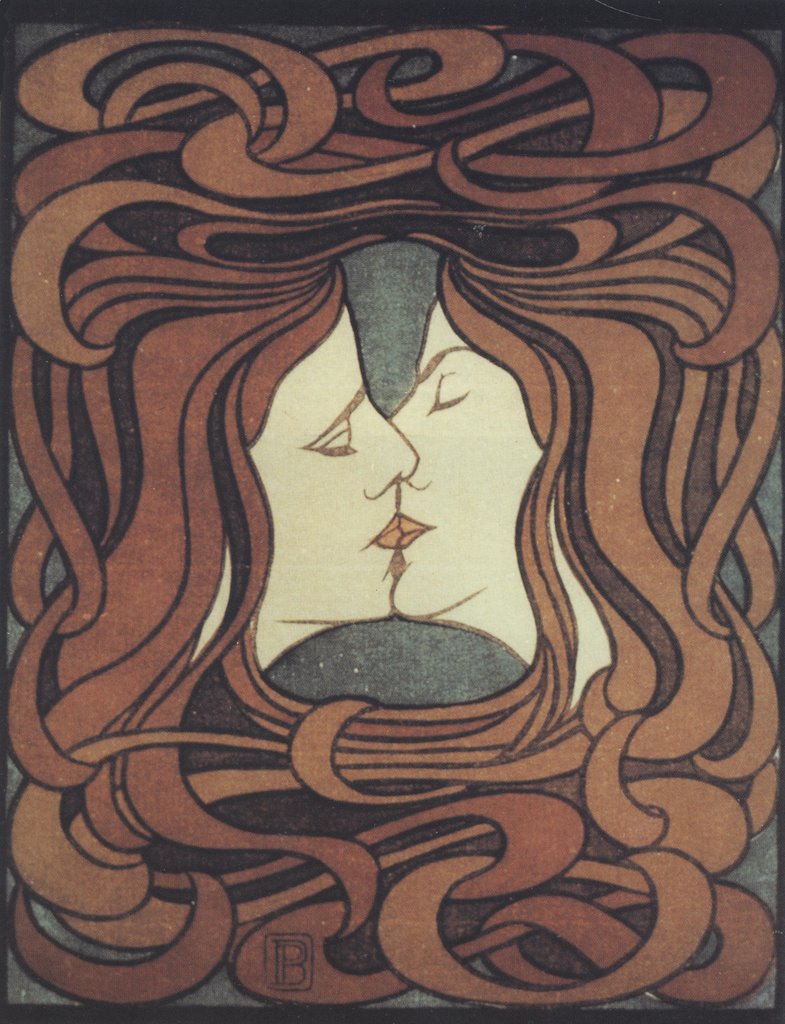
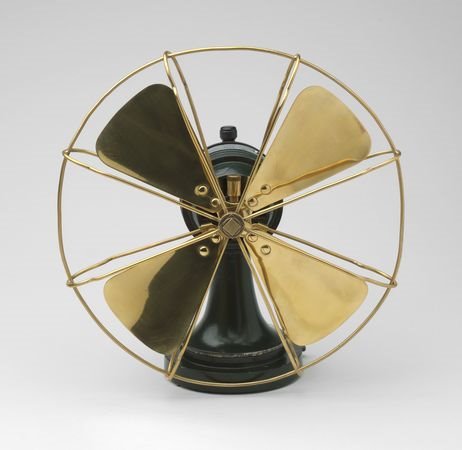
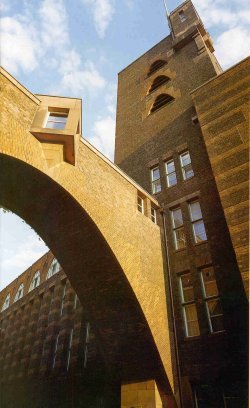
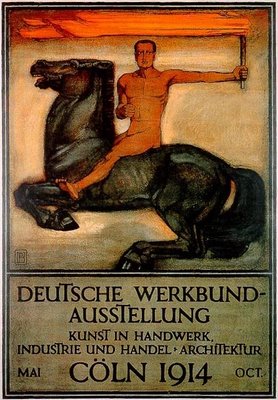 At the start of the 20th century, artists and designers were excited by the prospect of a new era filled with miraculous inventions such as telephones and cars. Science promised a world where humans could begin to create their own environment. But artists with vision recognized that there was also a danger: a man-made world could easily devolve into an industrial wasteland of purely functional objects unless artists were up to the task of creating new designs and forms suited for the machine age. Only designers could preserve beauty in an era when industrialization and mass production began to replace nature. Perhaps the greatest visionary of this period was Peter Behrens, an illustrator for the magazine Jugend, as well as a designer, architect, typographer, teacher and author. He has been called "the first industrial designer."

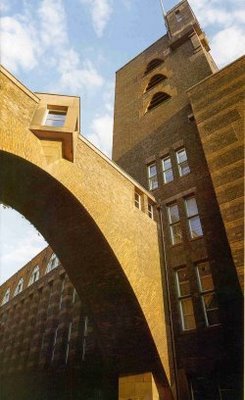
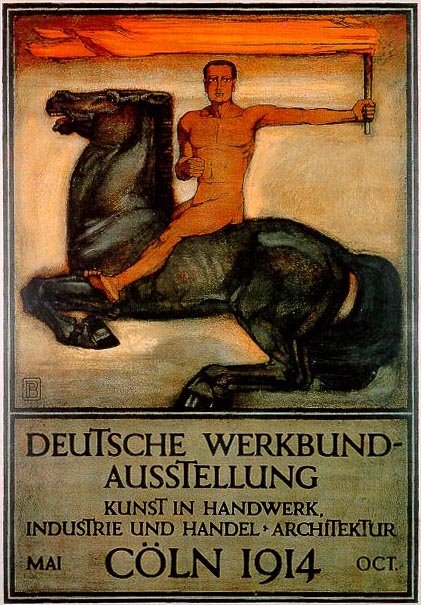
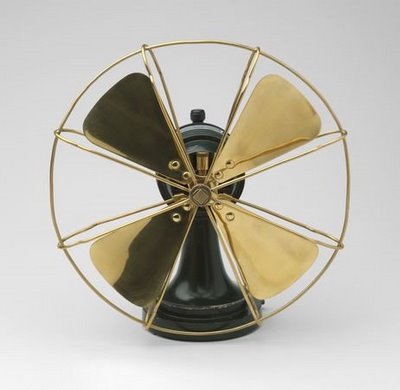 Behrens designed buildings, stationery, electrical appliances, silverware, typefaces, furniture and environments. He served as the design advisor to one of the world's largest manufacturing concerns, helped to found the German Association of Craftsmen and taught classes that would later become the conceptual underpinning for the Bauhaus. Most of all, he nurtured young apprentices who went on to become the titans of modern design, including Mies van der Rohe, Gropius and Le Corbusier. Behrens said he designed for the modern world by returning to "the fundamental principles of all form creating work."
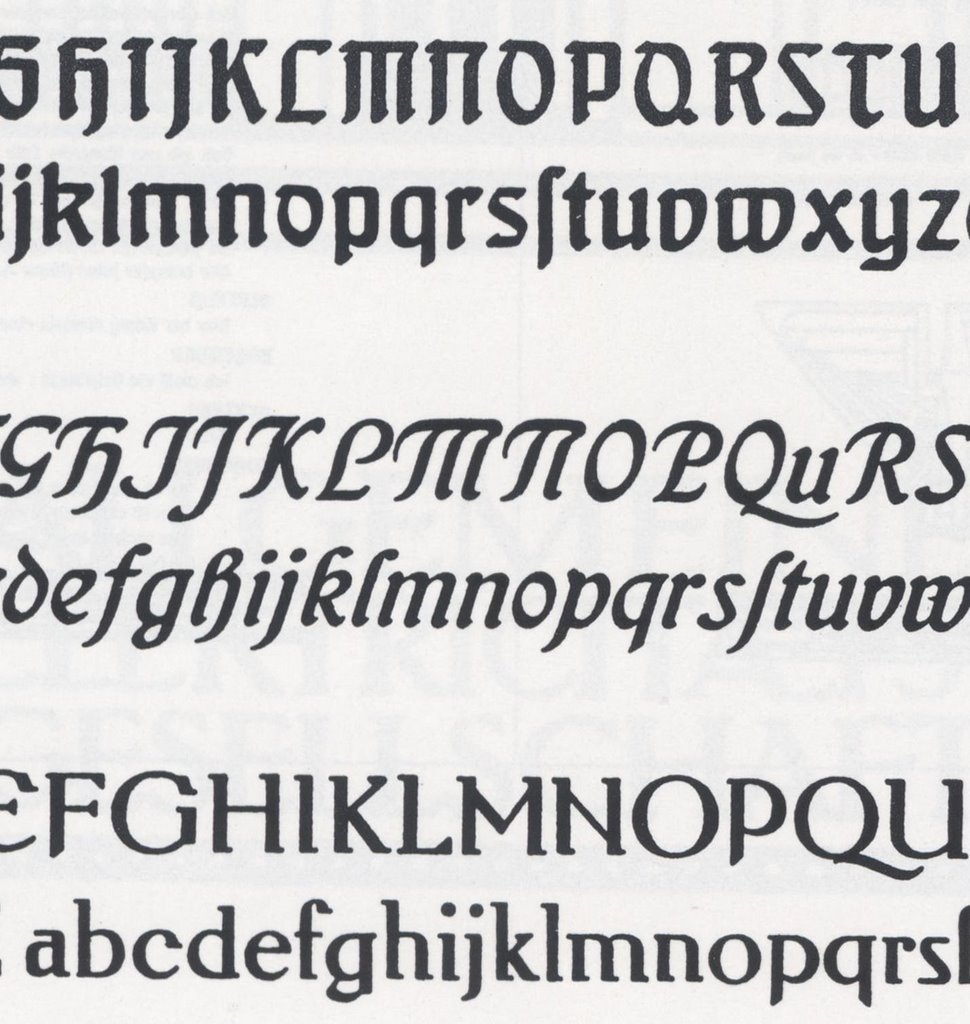
 Behrens also designed several typefaces that became standards for the 20th century.
 When designing type, he compared the process of the human eye reading text to
watching a bird's flight or the gallop of a horse. Both seem graceful and pleasing. But the viewer does not observe details of their form or movement. Only the rhythm of the lines is seen by the viewer, and the same is true of a typeface.
We all owe a debt to Behrens for helping to preserve a place for design in the human enterprise during the machine age.
But now the 20th century is over. Today's artists and designers face the new challenges of the 21st century. Who will be the new Peter Behrens who develops an aesthetic for the information age?
Information technology has deluged us with more data than we can assimilate-- a capability so dazzling that information has supplanted the role of wisdom or knowledge. As Karrie Jacobs noted, Computers have seduced us into thinking about ideas-- the intangible stuff that comprises our culture, our mental universe, our homegrown organic realities-- as information. Information has become the end product, rather than the means to achieve that end.
Just as Information can overwhelm our ability to convert data into knowledge, it can overwhelm our ability to process sensory input in aesthetic form. Information streams are added one on top of the other, like ornaments on a Christmas tree.
 The typical modern TV screen has a "crawl" with a message along the bottom, a "bug" identifying the station in the lower corner, and pop ups announcing the weather or the next show or the late breaking news. Anyone who has witnessed a message promoting the Gilmore Girls superimposed on the closing poignant moments of The Godfather knows that the domain of aesthetics has been overwhelmed by information. The same could be said of the cacophony of gateways to databases on websites, or even the designs appearing in many magazines. They are not integrated into our lives in an organic or intuitive way. For those artists who feel that the glory days of art and design are behind us, here is a challenge: whoever finds the artistic vision to apply "the fundamental principles of all form creating work" to the new information age will earn our undying gratitude.
###




 Posts
Posts

