
But wait a minute... it turns out that Van Gogh painted three other paintings just like it.
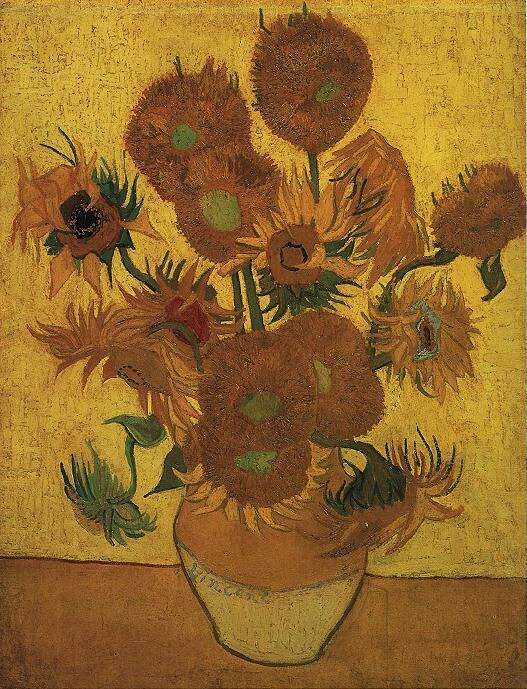
Or maybe it was four? Nobody knows for sure.

Someone argued that the $39.9 million painting must be a forgery, and suddenly it didn't look quite so beautiful.
Art experts hastily assembled to explain which of the five paintings had the "look" of a genuine Van Gogh. Unfortunately, the paintings had changed colors over time. The chrome yellow oil paint had darkened from exposure to atmosphere and the green paint changed color because of the copper acetoarsenite in the pigment.
So whatever the buyers were acquiring, it was not the artist's original vision.
Scientists, scholars, technicians, reporters and historians evaluated the painting. Some prepared long lists of issues:
The first of these concerns the leaf that belongs with the drooping flower to the left, number 14, through which the flower-stem passes. Leaves encompassing the stem in this way are not characteristic of sunflowers. In the first version-- the work in London-- the stem runs slightly into the leaf, which may have created the impression of a leaf encompassing a stem. The second concerns the broken stem of flower number 4. When sunflowers snap, the top part falls forward...but surprisingly this is not the case here.
Others claimed that the value of the art could be determined by a chemical analysis of the paint:
The composition of the priming layer allows us to date the work.... If this layer does indeed prove to consist of both barium sulfate and lead and/or zinc white, it would be reasonable to assume that the still life was painted in late November, when [Van Gogh] replaced the first type of primer with the second.
These are fitting topics for insurance companies and investment managers but not for people who care about art. For artists, it is the image that matters.
This all takes us back to digital art, which has an image but no physical existence. In recent exchanges, some of you have correctly pointed out that electromagnetic pictures create problems regarding scarcity, originality, authenticity, and even the fundamental nature of talent. But as the Van Gogh story demonstrates, so do physical objects. Sometimes the object becomes an albatross around the neck of art. Computer art may be dismaying to those who want to build a fence around an object and sell tickets, but for those who want to create digital images and cast them into the ether, computers give artists astonishing new tools.
There are days when I am utterly charmed by the idea of art without the constraints of earthbound objects. Those days are usually Saturday and Sunday, when I'm not trying to earn a living. But there are also days when the physical object is quite dear to me. We are fortunate to be living in a time of great transition. (I have a friend who claims that the invention of computers linked by the internet is slightly less important for human destiny than the invention of fire, but slightly more important than the invention of agriculture). These things will take time to work out.
For me, the one sure guide as we go forward is the quality of the image. I enjoy the work of dozens of computer artists, and in the past couple of weeks, you have alerted me to many more. I hope that readers have, with me, been exploring the links that have been suggested.
I agree with many of you that Craig Mullins is an extremely strong digital (as well as conventional) artist. The man knows how to draw and paint, and he enlists the computer to serve that talent as well as anyone I've ever seen.


Mullins has a good sense of color and drama and a real flair for design and I shall be visiting his website regularly.
One of my favorite young digital artists is Daisuke “dice” Tsutsumi , a visual development artist for animated films such as Robots. Like Mullins, Tsutsumi also works in traditional media:

Here he offers an excellent digital painting workshop showing how to use photoshop to paint an apple that looks as juicy as a Dean Cornwell oil painting. He is still growing, but I especially like Tsutsumi's attitude toward art. He chirps happily about drawing and painting while traveling, while standing in the rain, while eating lunch at his job or visting his family. He reminds me of a line from Jake Berthot:
An artist is rich if he has time. 'Making it' means having the time to make your work.Tsutsumi does "quick fun photoshop sketches" as seamlessly as he draws on a restaurant placemat. He is of the generation that will really begin to integrate and humanize computer art.


 Posts

